3. Performance
3.1. Measuring performance
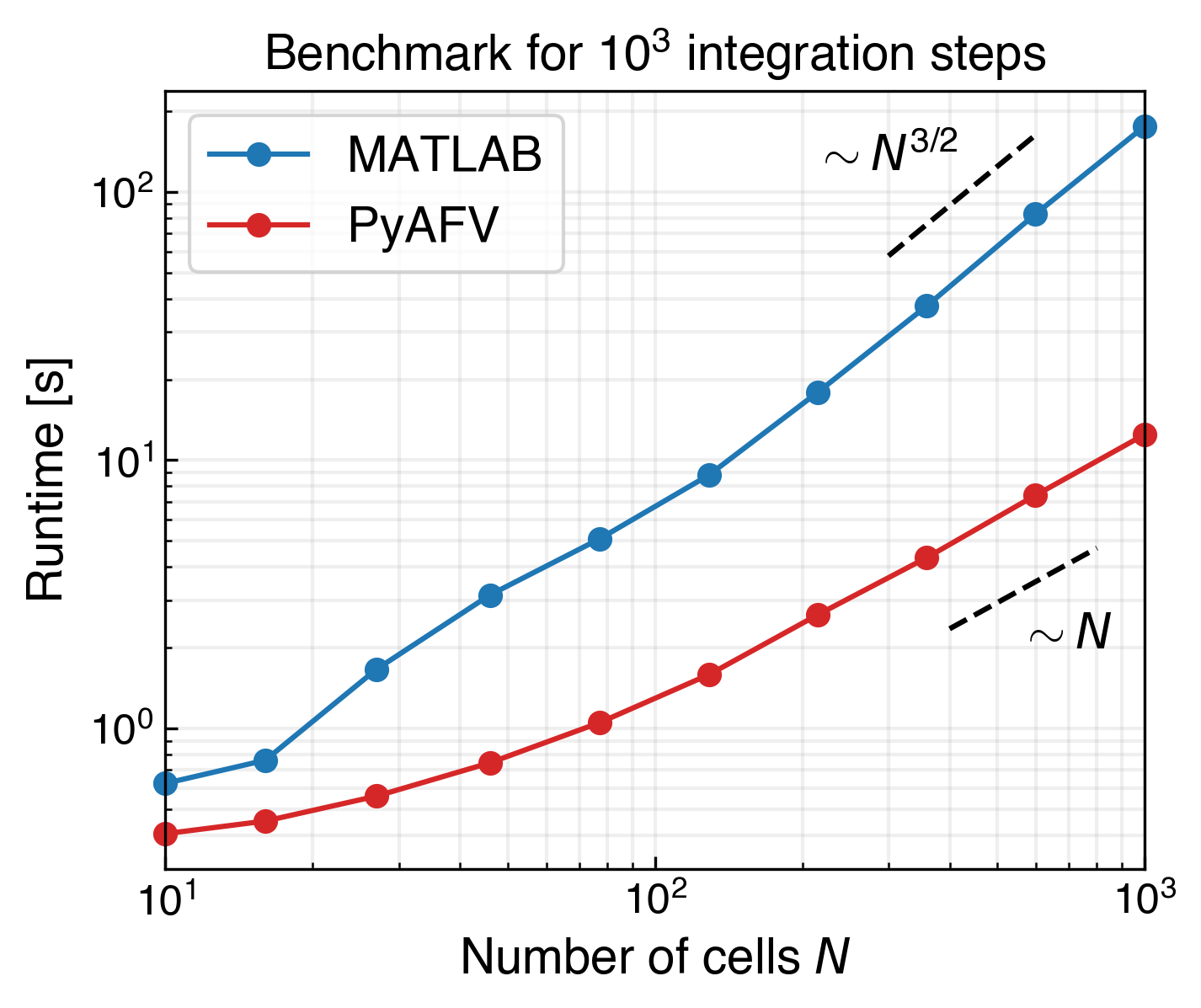
PyAFV has been benchmarked against the MATLAB implementation of the active-finite-Voronoi model from Ref. [1] by measuring the wall-clock runtime for simulations of varying system sizes. The results are shown in the figure; each data point corresponds to \(10^3\) integration steps, averaged over three independent runs. The results show that PyAFV exhibits near-linear scaling, approximately \(\mathcal{O}(N)\), whereas the original MATLAB code appears to scale as \(\mathcal{O}(N^{3/2})\). This difference leads to a significant speedup, particularly for large systems (\(N\gtrsim 10^3\)).
Note
All benchmark results were obtained on a MacBook Pro (14-in, 2024) equipped with an Apple M4 Pro chip (12-core) and 24 GB of RAM, running macOS 15.6. The MATLAB implementation was executed using MATLAB R2025a, while PyAFV was run using Python 3.13.5 with the PyAFV v0.4.1 default Cython backend.
3.2. Benchmarking backends
In addition, there is a set of lightweight benchmarks in tests using pytest-benchmark, e.g., test_bench_build.py compares the runtimes of the Cython and pure-Python backends . To run it:
(.venv) $ uv run pytest tests/test_bench_build.py --benchmark-only --benchmark-warmup on --benchmark-histogram
This will display the benchmark results and generate an interactive SVG histogram file (click to see the detailed timing results for each method):
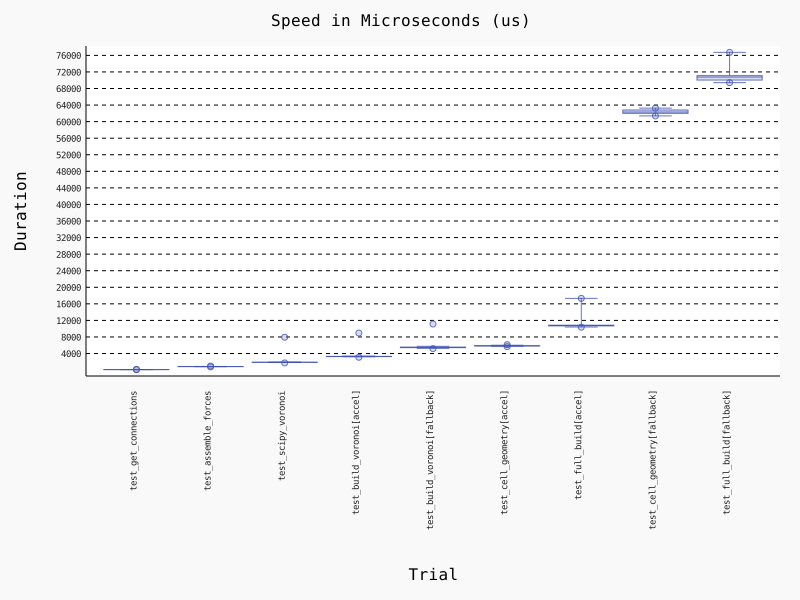
The histogram above summarizes the runtimes of the core routines invoked by pyafv.FiniteVoronoiSimulator.build() for a system of \(N=1000\) cells. The test_scipy_voronoi benchmark measures the execution time of SciPy’s Voronoi tessellation, which serves as a baseline for comparison. This SciPy routine is called internally by pyafv.FiniteVoronoiSimulator._build_voronoi_with_extensions(), corresponding to the test_build_voronoi benchmark shown in the histogram. From this comparison, we see that SciPy’s Voronoi computation accounts for approximately 60% of the total runtime of that method.
Hint
The suffixes [accel] and [fallback] in the benchmark names indicate whether the Cython backend or the pure-Python fallback implementation was used.
The remaining dominant cost arises from the additional per-cell processing performed in pyafv.FiniteVoronoiSimulator._per_cell_geometry(). As shown in the histogram, the Cython-backed implementation substantially reduces the runtime of this step, bringing it down to a level comparable to that of SciPy’s Voronoi tessellation.